Training Birds With Positive Reinforcement: A Complete Guide
The moment a bird steps up onto your hand willingly, comes when called by name, waves on cue, or says something contextually appropriate to the situation, you see something important: this is an animal that chose to engage with you. It wasn’t forced. It wasn’t manipulated into compliance. It chose the interaction because its history with you has associated that interaction with good things. That’s what positive reinforcement training produces, and it’s fundamentally different from what punishment-based methods produce.
The Science: Why Positive Reinforcement Works for Birds
Birds are operant learners — they associate their own behaviors with consequences and adjust those behaviors based on those consequences. Behavior that produces good consequences happens more. Behavior that produces neutral or negative consequences happens less or stops. This is not complicated, but it has profound practical implications for training.
The key principle: to increase a behavior, pair it consistently with something the bird values immediately after the behavior occurs. To decrease a behavior, remove what’s reinforcing it (extinction) rather than adding something aversive (punishment). Punishment with birds is counterproductive — it adds fear and stress to the interaction, damages the relationship, and doesn’t teach the bird what to do instead. A bird who is afraid of you is a bird who can’t learn well, who will develop defensive behaviors including biting, and who will have a fundamentally worse quality of life than one who sees you as a source of good things.
Finding Your Bird’s Motivators
Different birds are motivated by different things. Food is the most commonly used reinforcer and the most reliable for training — but the specific food matters enormously. A piece of kibble offered to a bird as a training reward may produce no behavioral change if the bird is indifferent to it. A small piece of the bird’s absolute favorite food — often something they don’t get freely — produces immediate motivation.
Common high-value training treats: millet spray (for small birds), a piece of walnut or almond (for parrots), a small piece of fruit the bird loves, a bite of cooked sweet potato. For some birds, the training interaction itself is motivating — they love the game. For others, a brief access to a favorite toy is reinforcing. Identify what your specific bird most values and use that in training.
Timing: The Critical Variable
The reinforcer must follow the behavior within approximately two seconds for the association to form reliably. Any longer and the bird may be in the middle of a different behavior when the reward arrives — and that’s the behavior that gets reinforced. A clicker (a small device that makes a distinct clicking sound) bridges the gap between the behavior and the treat delivery. The process: condition the bird to understand that click = treat coming (click, treat, repeat 20 times). Once conditioned, the click marks the exact moment of the desired behavior, allowing precise timing even if treat delivery takes a moment.
The Foundation Behaviors
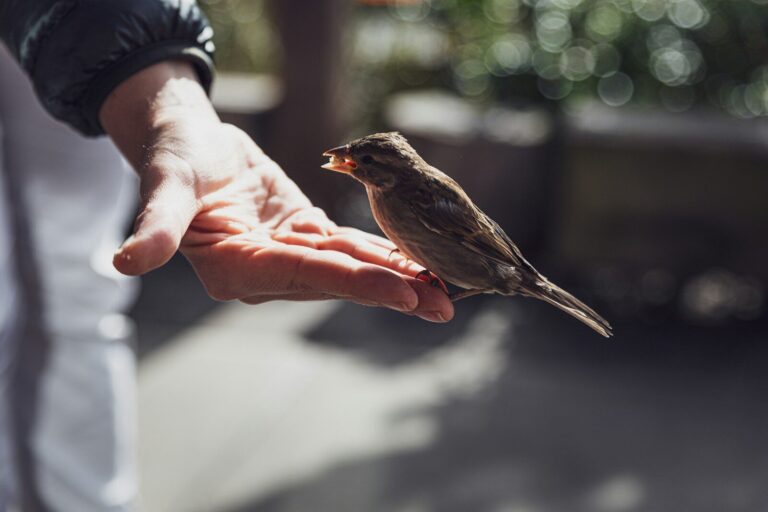
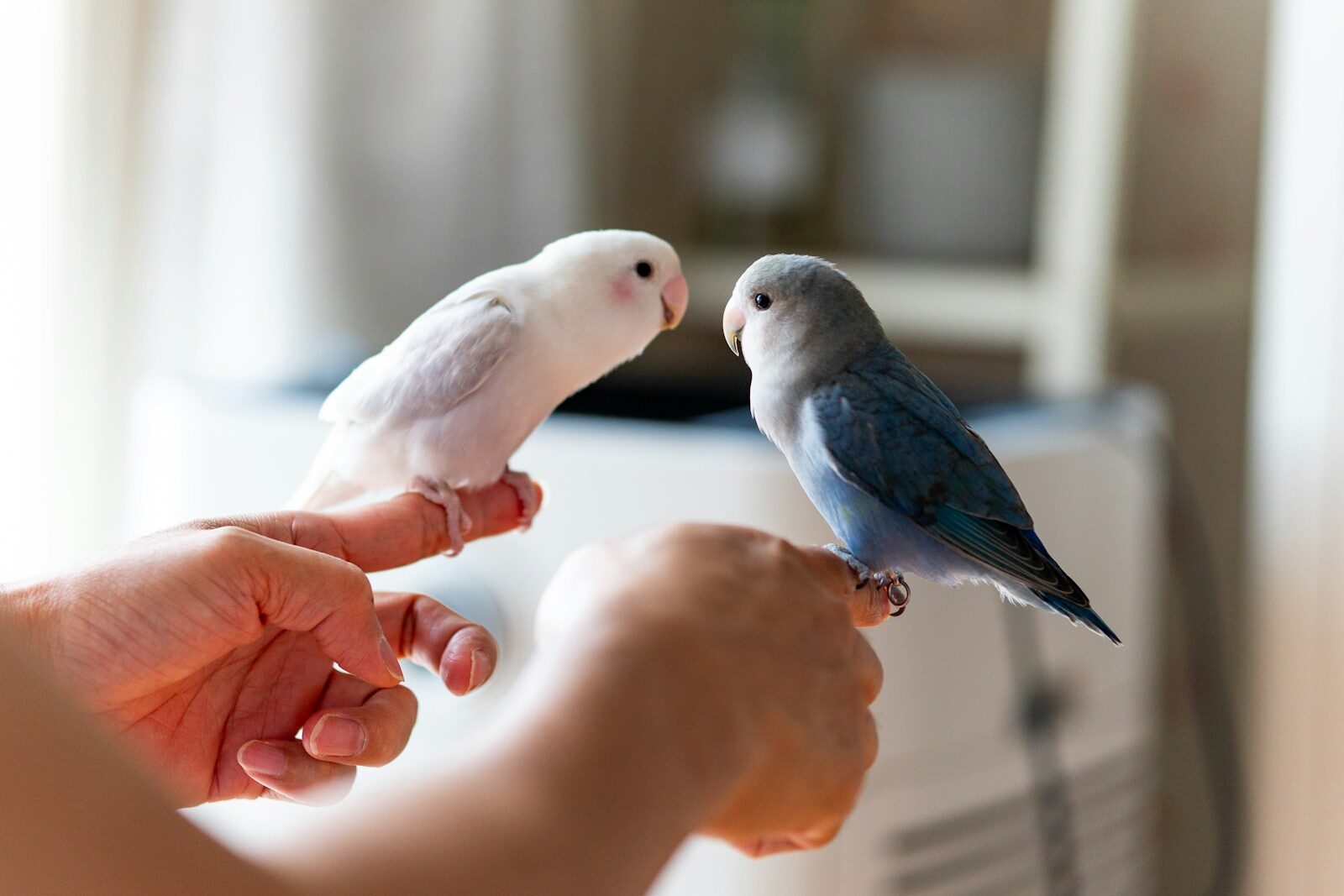
Step-up: The most fundamental behavior — the bird steps from its current position onto your offered finger or hand. Present a finger horizontally at the bird’s foot level, gently pressing against the lower belly above the feet. This physical pressure triggers a stepping-up reflex in most birds. The instant the bird steps up, reward. Repeat until the bird steps up reliably to the physical cue. Then add a verbal cue (“up” or “step up”) immediately before the physical cue, and gradually fade the physical cue as the verbal cue becomes the signal. A reliable step-up makes every other aspect of bird management — including veterinary care, cage cleaning, and emergency handling — significantly easier.
Targeting: Train the bird to touch a target (your finger, a chopstick, a pen) with its beak. Hold the target near the bird’s beak — most birds will touch it out of curiosity. Click and treat the moment of contact. Repeat. Once the bird is touching the target reliably on cue, use the target to guide the bird to specific locations, onto scales, through obstacle courses, or through any movement you want to train. Targeting is the foundation of almost all complex behavior training.
Station training: Train the bird to go to a specific location (a mat, a stand, a specific perch) on cue and remain there. This is invaluable for managing the bird when you need it out of the way (cleaning, visitors who are nervous of birds) and for veterinary weighing.
Session Structure for Optimal Learning
Keep sessions short — five minutes maximum, preferably two to three minutes. End while the bird is still engaged, not after it loses interest and wanders away. Multiple short sessions daily are dramatically more effective than one long session. End every session on a success — if the bird isn’t getting something, step back to something they know well, reward that, and end there. The bird should always leave a training session having succeeded and earned reward. This maintains the bird’s enthusiasm for training as a positive activity.
Troubleshooting
Bird isn’t taking treats: the treat may not be valuable enough, the bird may be full, or the bird may be too stressed to engage. Try a higher-value treat, train before a meal (when the bird is hungrier), and ensure the training environment feels safe. Bird stops responding mid-session: it’s probably done for this session — let it go and try again later. Bird bites during training: back off to a less intense step, let the situation cool down, don’t punish, and try again with a less challenging approach. Biting during training is information that you’re moving faster than the bird’s comfort allows. Slow down.
Beyond the Basics
Once foundational behaviors are reliable, the range of what birds can learn through positive reinforcement is genuinely remarkable. Waving, turning in circles, retrieving specific objects, putting objects in containers, opening latched boxes, playing basketball in miniature, solving multi-step puzzles, voluntarily entering carriers on cue — I’ve watched birds do all of these and more. The limit is usually the trainer’s creativity rather than the bird’s ability. Training is also genuinely enriching for the bird — it provides cognitive engagement, the satisfaction of mastery, and quality interactive time with its owner. For indoor birds whose natural behavioral repertoire is constrained by captivity, training is one of the most valuable quality-of-life additions available.