How to Tame a Scared Bird: Step-by-Step Guide That Actually Works
When someone calls me about a bird they can’t touch, can’t pick up, and who flees to the far corner of the cage at the sight of a hand, I don’t see an impossible case. I see a bird whose relationship with humans started wrong or never started at all, and a specific set of steps that will, with patience, build the trust that was missing. I’ve tamed birds that their owners genuinely believed would never be handleable. The method works. The variable is whether the owner will trust the process.
Understanding Why Birds Fear
A wild bird’s survival depends on fleeing predators. Humans — large, fast-moving, approaching from above (the direction predators come from in the wild) — trigger this hardwired fear response in birds who haven’t been positively conditioned to our presence. This is not a personality defect in the bird. It’s biology operating exactly as designed. Your job in taming is to create enough positive associations with your presence that the fear response is overridden by trust and positive expectation.
Two additional sources of fear in captive birds: past negative experiences with humans (being grabbed, chased, forcibly handled), and insufficient socialization during the early developmental window. Hand-raised birds who had daily positive handling from a young age start with a trust baseline that makes taming much faster. Parent-raised or aviary birds start from zero or below zero and take longer — but the same process works.
The Non-Negotiable Rules
Before the steps: these rules are not optional, and breaking them sets the work back significantly. Never grab or chase the bird. Never force physical contact. Never make loud sudden movements near the bird. Never punish the bird for fleeing or biting. Always end sessions before the bird shows high-stress signals. Progress at the bird’s pace, not yours.
Forced contact is the most common taming mistake. “Just grab it and hold it until it calms down” is advice I hear regularly and it is actively harmful. It confirms the bird’s fear, damages trust, and typically makes the bird harder to handle for weeks afterward. The bird does calm down under forced restraint — but what it’s experiencing is learned helplessness, not trust. The difference is significant and long-lasting.
Step 1: Presence Without Pressure (Days 1-7)
Begin by simply being near the cage, without attempting any interaction with the bird. Sit beside the cage, read a book, work on your laptop, have a quiet conversation nearby. Do not stare at the bird — prolonged direct eye contact is a threat signal. Use soft, indirect glances. Speak in a calm, conversational tone about anything — what you’re doing, what you’re thinking, what you had for lunch. The content doesn’t matter; the tone does.
Do this for 15-20 minutes twice daily. Your goal in this step is simply for the bird to associate your presence with nothing bad happening — no grabbing, no threat, just a large creature sitting nearby who is calm and non-threatening. Watch the bird’s body language: initial flight to the far corner of the cage, alarm calls, and puffing up are normal at first. Over days, the bird will begin showing less alarm at your presence — settling into a perch rather than panicking, watching you with curiosity rather than fear. This is progress. Don’t rush past it.
Step 2: Hand Near the Cage (Days 5-14)
Once the bird shows minimal alarm at your seated presence, begin slowly introducing your hand to the exterior of the cage. Move slowly — human speed reads as threat speed to a bird. Place your hand on the outside of the cage bars and hold it still. Don’t try to touch the bird through the bars. Just let the hand be there, motionless.
Initially the bird will move away. Hold the position until the bird’s alarm response reduces — stops calling, stops actively fleeing your hand’s location, and eventually investigates with curiosity. This may take one session. It may take ten. Hold it still; slow withdrawal teaches the bird that moving away makes the hand disappear, reinforcing avoidance.
Step 3: Hand Inside the Cage With Food (Days 10-21)
Introduce a high-value food the bird loves — millet spray for budgies, a favored treat for parrots. Hold the treat through the cage bar or just inside the open cage door, arm as still as possible, and wait. Do not move toward the bird. Let the bird choose to approach.
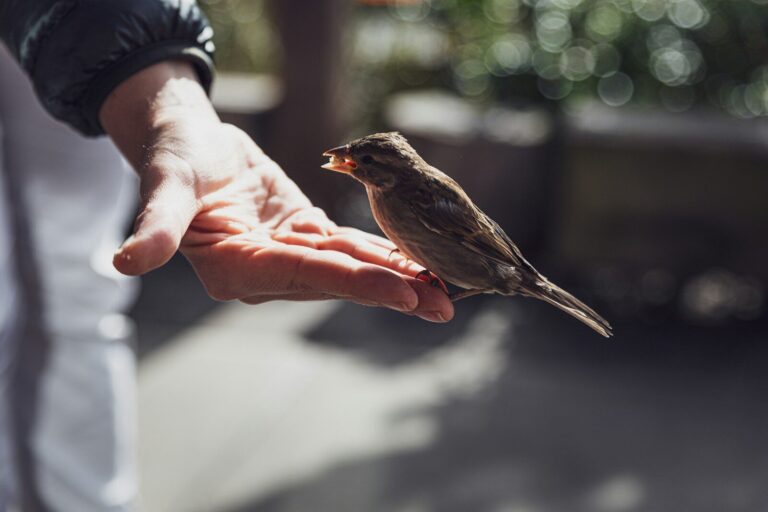
At first, the bird will not approach. That’s fine. Leave the treat at the position for 5-10 minutes, then end the session. Repeat. Eventually — it may be session 3 or session 15, depending on the individual bird — curiosity overcomes fear and the bird approaches to investigate. When the bird takes the treat from your hand, that’s a significant moment. The bird has made a voluntary positive choice to interact with you. Repeat this many times before proceeding.
Step 4: Perch Target Training (Days 15-30)
With the bird reliably taking treats from your stationary hand, begin moving the treat slowly to encourage the bird to come to different positions within the cage to reach it. The bird is now voluntarily following your hand — a critical shift in the relationship dynamic. From here, introduce a training perch (a short wooden dowel) held in your other hand alongside the treat, positioning it near the bird’s feet when they approach. The bird may step onto the perch to reach the treat.
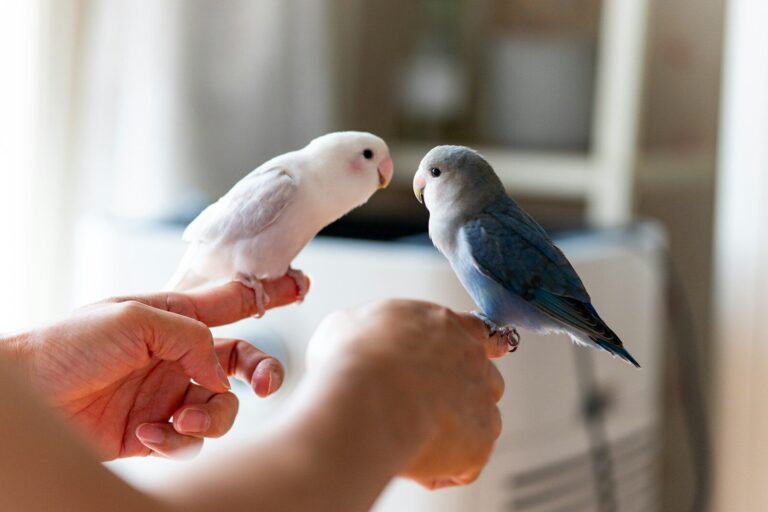
The step-up behavior — stepping voluntarily onto a finger or perch — is the foundational taming milestone. Once achieved reliably inside the cage, you can begin the same process outside the cage in a safe room, eventually building to confident handling outside the cage.
What to Do When the Bird Bites
Biting during taming is normal — it’s a communication signal meaning “I’m uncomfortable with what’s happening.” The appropriate response is not punishment. Simply remove your hand calmly, pause the interaction for a moment, and try again at a less intense proximity. Yelling at or punishing a bird for biting escalates fear and aggression and makes the situation worse. A calm, un-dramatic response to biting teaches the bird that biting doesn’t produce an interesting reaction — and over time, a bird who learns that biting achieves nothing gradually stops using it as a communication tool, while a bird whose biting produces dramatic responses uses it more.
Realistic Timelines
A hand-raised young bird who has lost tameness through neglect: one to three weeks of consistent work. An aviary-raised bird with no negative human experiences: two to six weeks. A bird with a history of forced handling or other negative human interactions: two to four months of careful, consistent work. Older birds with entrenched fearful behavior: three to six months minimum. None of these timelines are guarantees — individual variation is significant. But the process, applied consistently, works for the vast majority of birds. I’ve seen birds transform that their owners had written off. The method works if you work the method.